Thinking of buying a new EV? Here’s what you need to know
Nearly a quarter of all new vehicle purchases are now plug-in electric vehicles, and when you include conventional hybrid vehicles, that figure rises to 46 per cent of market share. So, based on recent University of Melbourne research, what does a new EV owner need to know about the differences between their old car, and their new electric-powered one?

Electric vehicle purchases in Australia have surged amid the ongoing war in Iran, as drivers worry about rising fuel costs. It's a trend that has persisted months now: with March, April and May 2026 electric vehicle (EV) sales all surpassing previous records.
By May this year, in Victoria, electric vehicles (EVs) accounted for nearly a quarter of all light vehicle sales, up from 9 per cent in January.
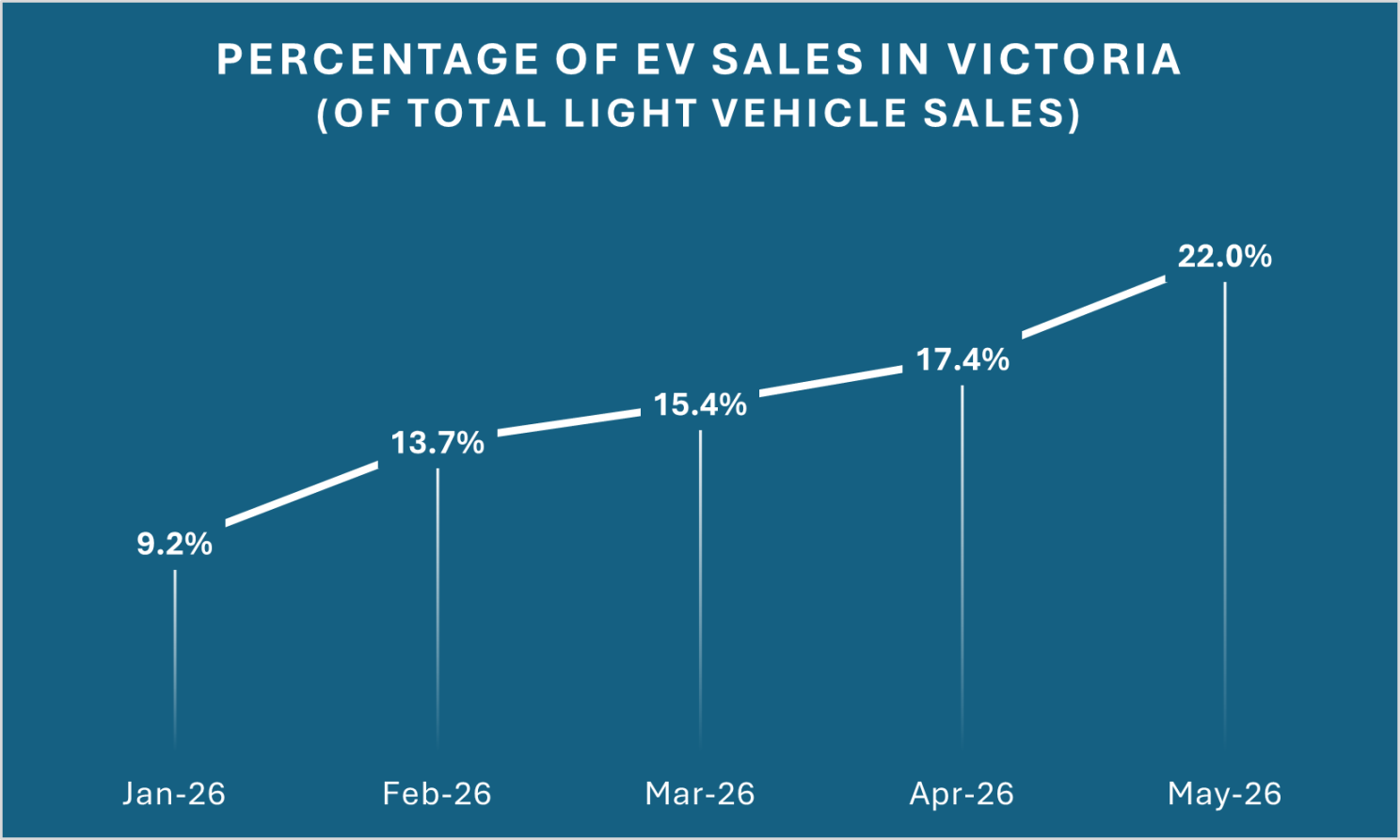
Graph: Victorian EV sales in 2026 as a percentage of total light vehicle sales. Source: Victorian Department of Energy, Environment and Climate Action (DEECA).
Nationally, the picture is much the same. EVs, including plug-in hybrids, made up 16.4 per cent of all new vehicle sales in April, and 20 per cent in May 2026, both months breaking previous records in market share recorded to date.
When considering electrified vehicles more broadly – including battery electric vehicles, conventional hybrid vehicles and plug-in hybrid vehicles – they accounted for 46 per cent of new vehicle sales from all sources during May. Trends in car insurance quotes follow suit, with NRMA reporting quotes for EV insurance had effectively doubled in 2026.
NRMA’s head of insurance research, Shawn Ticehurst, said it reflected a clear structural shift in how Australians are now thinking about EVs.
“At the same time, the EV market has matured significantly. There are now over 100 different models available across every major price tier, making EVs a viable option for more Australians than ever before,” said Mr Ticehurst.
The big drawcard: much cheaper running costs. As of 22 April, A$1 of electricity takes an EV 45 kilometres, while $1 of diesel gets you 5.4 km.
A quick guide for new EV owners
Driving an EV is fairly similar to a combustion engine car. The biggest difference is charging instead of refuelling.
For the growing number of new EV drivers on our roads, this quick guide outlines some of the key things to consider when making the switch.
– Dr Patricia Sauri Lavieri, Senior lecturer in the Department of Infrastructure Engineering, at the University of Melbourne
This guide is informed by recent research at the University of Melbourne's, led by Dr Patricia Sauri Lavieri and Isrrah Malabanan, with seed funding from the ABP-FEIT Collaboration Grant and the Melbourne Energy Institute. The researchers interviewed new EV owners, including renters and people living in apartments, documenting the practical advice they would offer others.
1. Driving experience
EVs generally offer a smoother ride with punchier acceleration compared to combustion engine cars.
One thing to watch for is speed. Because EVs have much more torque, they can accelerate much faster – and do so quietly. It can be easy to speed without meaning to. Using cruise control on freeways is a good idea.
Almost all EVs have regenerative braking, meaning the brakes recharge the battery.
Many EVs allow drivers to use just one pedal to accelerate and brake. To brake gently, you can take your foot off the accelerator and let the car slow itself down. But there’s still a traditional brake pedal.
2. Refuelling vs charging
Refuelling a combustion engine car is quick, but requires going to a service station. Charging an EV can be done at home, at work, in shopping centres and public charging stations.
Charging time varies depending on the speed of the charger, from slow Level 1 trickle chargers, Level 2 chargers and Level 3 fast or ultrafast public chargers. The cost varies by location, time and operator.
The cheapest and easiest method is to plug in at home and charge overnight at off-peak electricity rates or using solar during the day. Charging overnight at off-peak rates is cheap, while running off solar is effectively free. EVs and solar pair well.
Drivers who regularly do longer distances can install a faster wallbox charger at home.
For the millions of Australians who live in apartments, it may not be possible to charge at home. Public charging plays a vital role here.
3. Range anxiety is fading
Early EV adopters often experienced range anxiety – the fear of running out of charge mid-trip.
This concern is fading, as the average range of new EVs is now over 400 km. Research shows this anxiety fades away as drivers become comfortable with their vehicles, learn the distances they usually travel and use apps and maps to plan where they will charge during road trips.
As one EV owner revealed:
Charging is not something I really think about. Like, as soon as I get home and park, I just plug my car in and it charges automatically at 12 o'clock at night for 6 hours.
Home charging offers the biggest comfort. Most EV owners (93%) in Australia can charge at home, and most of them say home charging meets their travel needs.
Over time, EV owners learn the locations of more public chargers, which also reduces anxiety.
4. Public charging is the biggest challenge
It took decades to build Australia’s network of more than 6,600 service stations.
The public charging network has had much less time to develop. The network is significantly bigger than it was five years ago, but some issues remain.
The main challenge then shifts from range anxiety to charging anxiety. This is the fear of arriving at a public charging station only to find the chargers don’t work, have an incompatible plug, deliver slower-than-advertised speeds or have long queues, especially at peak times.
EV drivers suggest the solution is to check on public chargers before driving there. Real-time data about chargers is easy to come by.
Charging apps let you check charger reliability easily. If you can see a charger has been successfully used recently, it’s a good sign. Charger ratings and reviews help you decide.
Choosing chargers used by drivers with similar EVs is an easy way to ensure the charger has the right plug.
Much of this information is held in charging apps such as Evie, Chargefox or Tesla.
Apps such as PlugShare, Google Maps and the Electric Vehicle Council’s Charge@Large have data on chargers from many different networks.
5. Planning road trips
Longer distance trips require a little bit of planning.
- Use route planners such as A Better Route Planner to see where you will need to charge, find good charger options and identify backups
- Pack an EV travel kit with a charger cable and extension lead
- Allow time for charging, queues and possible detours, especially during busy periods. Aim to charge before the battery drops below 20%.
Some new EV owners may find public charging a hassle compared to a quick refuel stop. But there are perks.
Many regional charging stations are located in the centre of a town. As one EV owner told us:
Just plug it in there, stroll up the street, have a coffee, grab a muffin or something. By the time you come back, the car’s charged.
6. Drivers are quick to adapt
As with any new technology, switching to an EV has a learning curve. The good news is the curve is not steep, despite some critical media reports.
Drivers adapt quickly. As they gain experience, EV owners develop charging habits and smart trip planning which become second nature. Range and charging anxiety dissipate.
Worldwide, over 90% of EV owners plan to make their next car an EV too.
For more information about this research, contact Senior Lecturer, Dr Patricia Sauri Lavieri , or PhD Candidate, Isrrah Malabanan, from Transport Engineering, in the Department of Infrastructure Engineering, at the University of Melbourne .
This article has been adapted and republished from The Conversation under a Creative Commons license. Read the original article.