MEI Symposium 24
A showcase of leading research on the energy transition. Plenary recording and presentation now available.
The Melbourne Energy Institute’s annual symposium once again showcased diverse research for a clean energy future.
It convened many hundred attendees, who heard from 26 energy experts across MEI's 4 research programs.
“Thanks to each and every presenter for generously sharing your expertise at the MEI Symposium,” said MEI Director, Professor Michael Brear.
“Thanks also go to all attendees for making the time to connect with the University and MEI. I hope you were as impressed as I was with the diversity of wonderful work presented by University researchers as well as by our friends at Climateworks, the CSIRO and industry,” Professor Brear said.

Matching ambition by design: Opening plenary discussion
Five systemic shifts are required to accelerate the transition to net-zero energy, and simultaneously, prepare Australia to become a renewable energy superpower. This was the thesis put forward by Anna Skarbek, CEO of the Climateworks Centre and the Symposium’s opening speaker.
From new energy market rules and stronger integration of energy efficiency in planning, to financial and reporting instruments which favour climate-safe investments, Anna laid out critical steps to enable electrification while growing Australian exports of renewable energy and clean commodities.
View the plenary recording
Download the plenary presentation
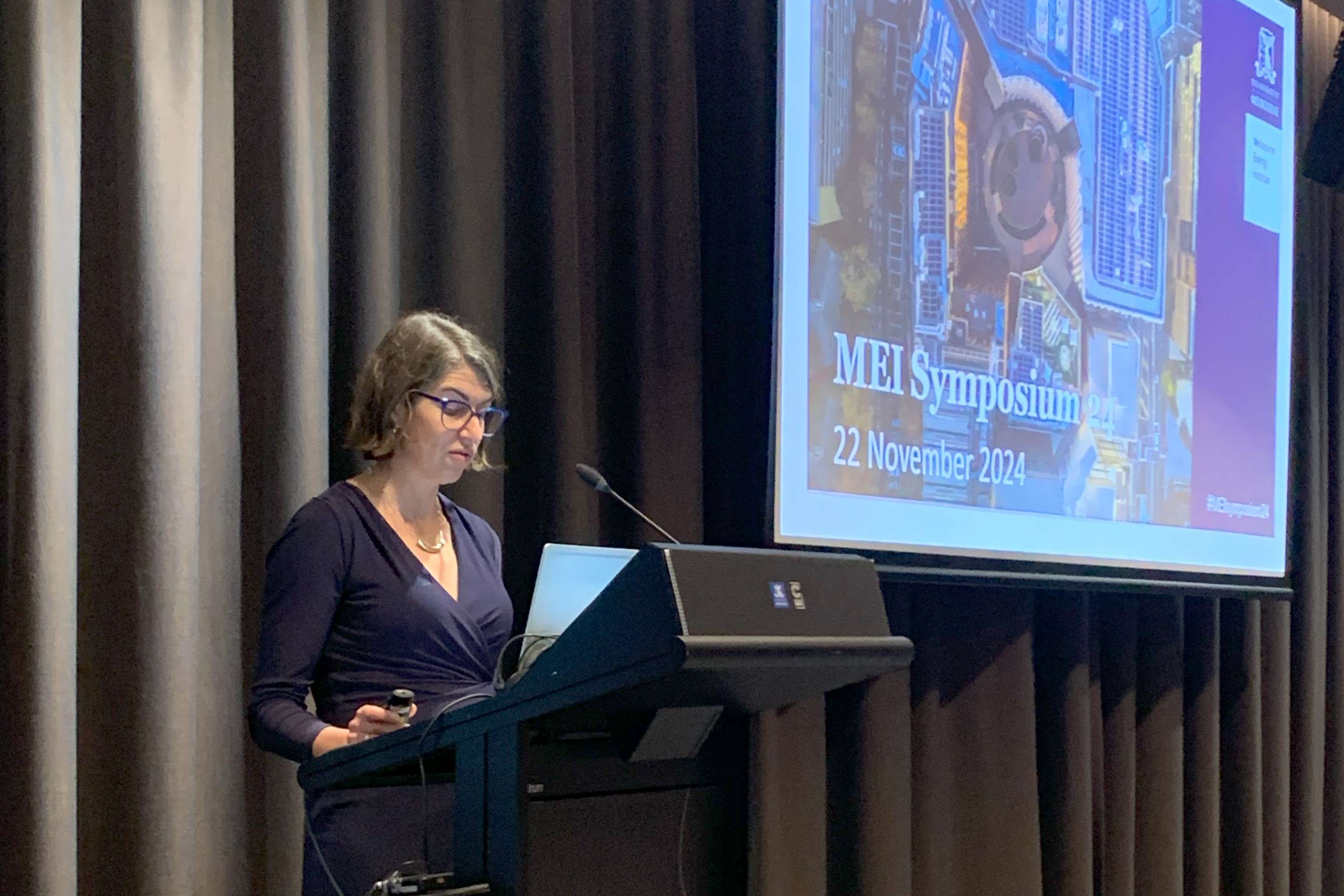
Above: Climateworks CEO, Anna Skarbek discussing five critical shifts to align our energy system with our expectations of becoming a renewable superpower.
Four research streams each shared five breakthrough areas of research
Session 1: Energy Systems
Chaired by MEI’s Energy Systems program leader, Prof. Pierluigi Mancarella, this stream looked at how clean energy technologies integrate with one another, society and the environment.
The session's keynote, delivered by the university's Prof. Kate Smith-Miles, explored a range of methods for better decision making to optimise energy system performance (and the merits of ditching spreadsheets!).
As part of this session, presenters also explored techno-economic assessments and electric grid stability, along with residential energy decarbonisation and hydrogen for energy storage.
Session 2: Energy Materials
MEI program leader, A/Prof. Wallace Wong, chaired the Energy Materials discussion, focused on the discovery and optimisation of materials for energy applications.
The session started with the university's Prof. Amanda Ellis’ keynote, looking at the evolution of battery technologies and how improving graphite anodes can improve performance.
Researchers also presented pioneering work in semiconductor nanocrystals, new cell architecture for solar photovoltaics, advanced spectroscopic techniques and proton transport.
Session 3: Power Generation and Transport
Director of the Australian Centre for Offshore Wind Energy, A/Prof. Shiaohuey Chow, chaired this session. It focused on renewable and low emission fuels for both stationary and transport energy.
The session was kicked-off by keynote speaker, Dr. David Harris, Chief Research Consultant from CSIRO Energy, who delved into technology pathways for sustainable energy systems. It explored hydrogen as an energy carrier, enabling technologies in gasification and supply-chain linkages, and the need for practical, industrial demonstrations.
David was followed by presenters discussing the potential of geothermal energy across the Gippsland region, assessment of long-term trends in wind energy density off the Australian coastline, and the next frontier in aircraft engines.
Session 4: Heavy Industry and Resources
Chaired by A/Prof. Colin Scholes on behalf of Heavy Industry and Resources Program Leader, Professor Kathryn Mumford, this session focused work accelerating decarbonisation in these sectors.
The session began with a keynote from Barry Hooper, Executive Director from KC8 Capture Technologies, who discussed the company’s work in commercialising, cost-effective, chemical carbon capture for use by fossil fuel energy and heavy industrial sectors.
Barry's talk was followed by presentations on high temperature hydrogen electrolysis, cryogenic hydrogen, and carbon-negative ammonia or green hydrogen production from the air!
MEI Symposium 24 was held on 22 November 2024 at Melbourne Connect.
Review the program, or to find out first about next year's symposium, subscribe to our newsletter.