Spotlight on a researcher: Foojan Kazemzadeh Haghighi
Exploring microscopic ways to trap carbon dioxide in stone.
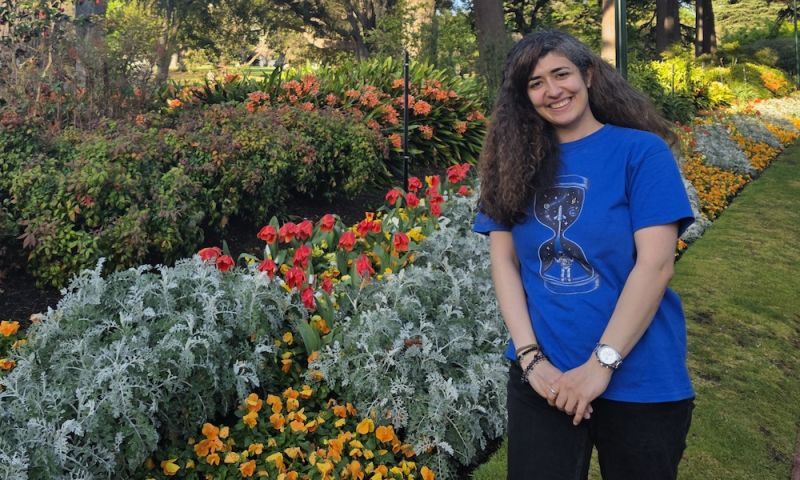
How can we trap some of the world's excess carbon dioxide in the tiny pores of reservoir rocks? That’s the question explored by Foojan Kazemzadeh’s PhD at the University of Melbourne. Her research combines imaging, data analysis and simulation to better understand how fluids move through vesicular basalts, at a microscopic level, and improve how we assess geological storage.
In simple terms, can you tell us what your research is about?
My research concentrates on analysing the characteristics of reservoir rocks that can act as host formations for storing carbon dioxide. Geological carbon storage is one approach to mitigating climate change.
OK, now give us the technical terms!
My research sits at the intersection of subsurface fluid flow, digital rock physics, and pore-scale characterisation of heterogeneous porous media, with a particular focus on vesicular basalts.
I combine X-ray computed tomography (micro-CT) imaging alongside image processing, denoising, and advanced statistical analysis to extract key petrophysical properties. These insights are then applied in computational fluid dynamics simulations to better understand flow and transport behaviour in complex geological materials.
The ultimate goal is to improve upscaling from pore-scale observations to larger reservoir or field-scale models, with applications in geological carbon storage, hydrogeology and subsurface energy systems.
Why did you choose this area of research? What interests you about it?
I have always been passionate about the critical role of the microscopic world and how it influences large-scale environmental outcomes. The idea that void space and microscopic pore structures within rocks can contribute to solving a global challenge like climate change is a strong motivator for my work.
What’s the bigger picture? How will your work contribute to the transition to a clean energy system?
To meet decarbonisation goals, we must manage the CO₂ already present in the atmosphere. My research aims to improve the reliability of carbon capture and storage (CCS).
By better understanding fluid flow through complex pore structures of rocks, we can more accurately map this behaviour to larger scales, assess storage site capacity, and position CCS as a viable bridge to a low-carbon energy system.
What did you study to get here?
I hold a Bachelor and Master of Science in Petroleum Engineering, which provided a strong foundation for my understanding of how fluids behave underground. Before joining the University of Melbourne, I worked in industry for a year, focusing on data science and developing automated workflows; for root cause analysis and compliance assessment in a health, safety and environment context.
And what comes next?
I am currently researching vesicular basalts, which have gained attention in recent years for their ability to mineralise CO2 into solid forms. My work aims to better understand their unique properties and how they differ from conventional sedimentary rocks.
I am on track to complete my PhD in January 2027. Following this, I hope to apply my expertise to projects focused on subsurface energy and sustainability.
Do you have any recent publications to share?
- Haghighi, Foojan Kazemzadeh, et al. "Statistical determination of representative elementary volume for petrophysical properties of vesicular basalts." Advances in Water Resources (2025): 105173.
- Fathy, Mohammad, et al. "Technological Approaches to Overcoming Geothermal Well Integrity Challenges: A Review of Modern Solutions." Geoenergy Science and Engineering (2025): 214308.
Foojan Kazemzadeh Haghighi is a PhD researcher in the School of Geography, Earth and Atmospheric Sciences at the University of Melbourne. Her research focuses on pore-scale modelling, digital rock analysis and subsurface fluid flow, with applications in geological carbon storage and energy systems. You can contact Foojan by email or LinkedIn for more information about her research.