View the recording: MEInetwork24 Seminar #6 - Enabling the DER revolution - from dynamic pricing to virtual power plants, energy communities, and microgrids
Share via
The Melbourne Energy Institute hosted the sixth MEInetwork seminar for 2024, presented by Professor Pierluigi Mancarella, MEI's Energy Systems Program Leader, Chair Professor of Electrical Power Systems at the University of Melbourne, and Professor of Smart Energy Systems at the University of Manchester, UK.
About
Making the demand side more active and flexible is considered the Holy Grail to enable integration of renewable energy into power systems and markets and whole-system decarbonisation.
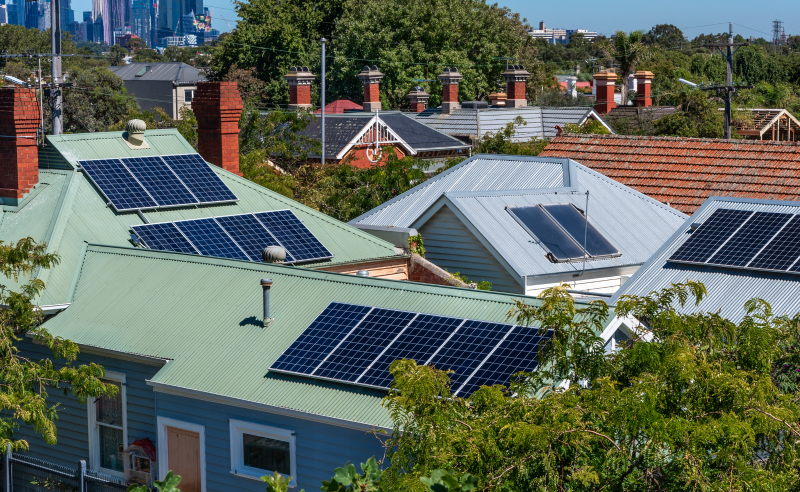
In this regard, Distributed Energy Resources (DERs) embedded in distribution networks are becoming widespread in most countries worldwide. In Australia, in particular, household-level consumer energy resources (CERs) such as rooftop solar photovoltaics, battery energy storage systems, electric heat pumps, and soon electric vehicles, are poised to play an essential role towards net-zero targets and more consumer-centric system developments. Local energy systems with shared assets such as community storage are also emerging as important options of interest. Key ongoing debates now refer to how different distributed technologies and schemes should be fully integrated into power and energy systems and markets.
In this lecture, we presented fundamental techno-economic aspects of key approaches that could enable large-scale deployment of DERs and CERs – from dynamic pricing to virtual power plants, energy communities, and microgrids – and discussed the benefits of demand side integration into systems and markets. Several case studies from recent projects in Australia and internationally were used to exemplify the concepts presented.
Speaker

Professor Pierluigi Mancarella
Chair Professor of Electrical Power Systems, and Melbourne Energy Institute Energy Systems Program Leader, University of Melbourne
Professor of Smart Energy Systems, University of Manchester
Pierluigi Mancarella obtained his PhD degree in Power Systems from the Politecnico di Torino, Italy, did his post-doc at Imperial College London, UK, and has held visiting research positions at Sintef/NTNU in Norway and NREL in Colorado, as well as visiting professorships at Ecole Centrale de Lille in France, the Universidad de Chile, and Tsinghua University in China.
Pierluigi has been involved in/led, in the last 15 years, some 50 research projects and consultancy and professional activities in the UK, Australia, and internationally, in the area of grid integration of renewables and distributed energy resources, techno-economic modelling of low-carbon power systems, business cases for smart grid technologies, reliability and resilience assessment of future networks, multi-energy systems and sector coupling, and energy infrastructure investment under uncertainty. Pierluigi is author of several books and book chapters, and of over 200 research papers. He is an Editor of the IEEE Transactions on Power Systems, IEEE Transactions on Smart Grid, IEEE Systems Journal, and the brand-new Oxford Open Energy journal. Pierluigi is also an IEEE Power and Energy Society Distinguished Lecturer, the first Chair of the Energy Working Group of the IEEE European Public Policy Initiative, and the Convenor of the Cigre Working Group C6/C2.34 "Flexibility provision from DER". He led the power system security assessment studies commissioned by the "Finkel Review" panel and actively collaborates as a researcher and consultant for industry and government bodies, including AEMO, AEMC and AER.
About the MEInetwork24 Seminar Series - a deep dive into the electricity supply chain
The aim of the MEInetwork Seminar Series is to give participants a sound understanding of the current technical and economic factors that underpin the Australian energy system. Knowledge of these market factors is critical in determining the changes required to move towards a clean energy system.
Each year, the focus is turned to one of our primary energy vectors, cycling through the major topics of electricity, natural gas, and energy commodities.